Does Gun Policy Draws the Highest Level of Combined Urgency in Tennessee Survey

by Brandon Burley and The Redemption Project
As additional responses are analyzed, a pattern has begun to take shape across multiple policy areas.
Education policy and funding drew 43% of respondents rating it as “Critical.”
Healthcare access and affordability followed closely at nearly 44% “Critical.”
Jobs and the state economy registered 47% as “Very Important.”
Infrastructure and transportation came in at nearly 39% “Very Important.”
Those figures suggest attention distributed across several areas of governance.
Gun policy presents a different pattern.
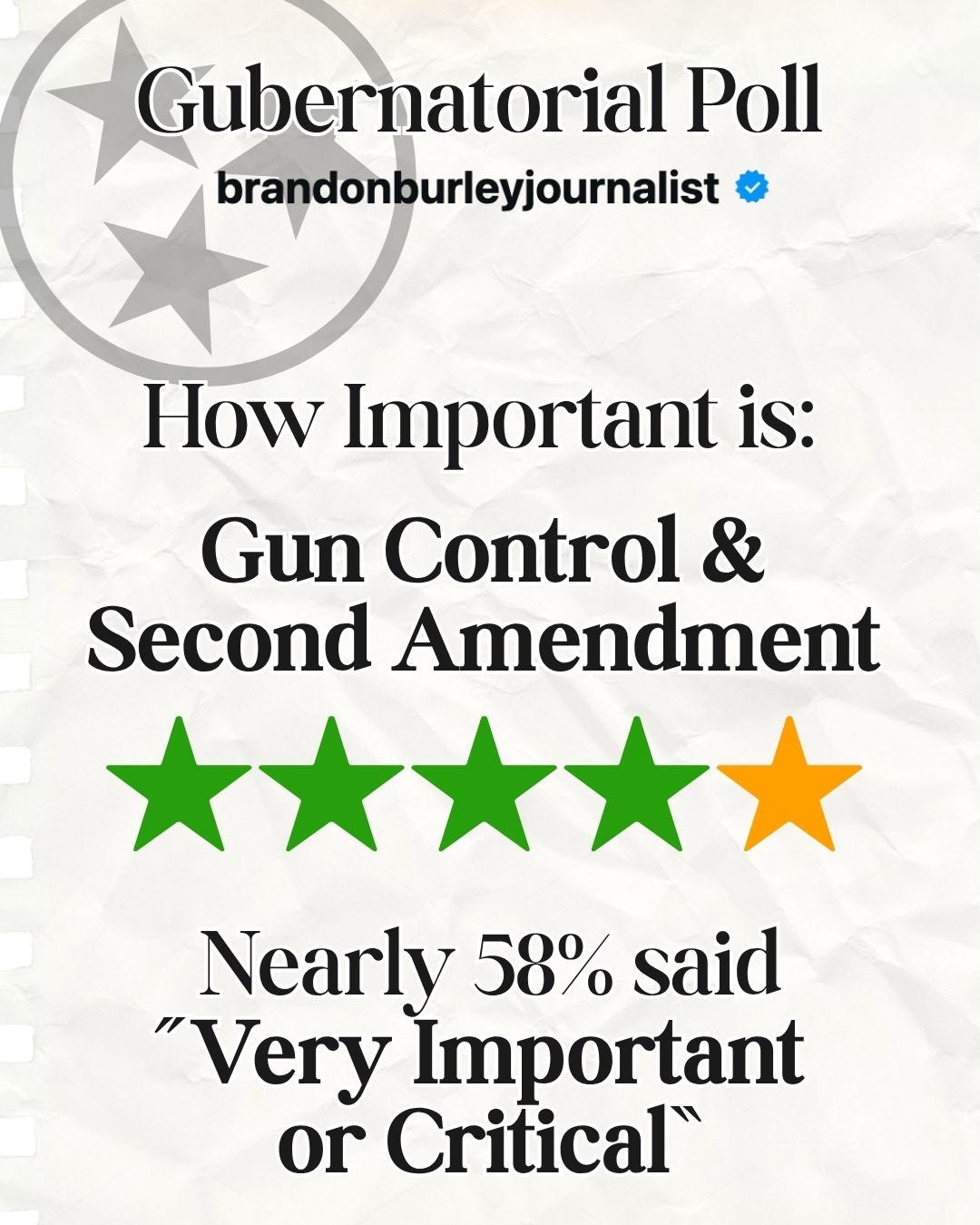
In the current dataset, based on 2,807 responses across all 95 Tennessee counties, nearly 58% of respondents rated gun control and Second Amendment issues as either “Very Important” or “Critical.”
That is the highest combined level of urgency observed among the issues measured
Unlike other policy areas, gun policy tends to reflect not only practical concerns but underlying views on rights, public safety, and the role of government.
That distinction shapes how the issue is approached at the state level.
A Governor’s influence includes:
support for or opposition to state-level firearm regulations
coordination with law enforcement on enforcement priorities
positioning the state in relation to federal policy initiatives
shaping broader public safety frameworks tied to firearm use
While the scope of authority is defined by both state and federal law, the office still plays a meaningful role in how policy is developed and applied.
The data does not indicate consensus on policy direction.
It does indicate that the issue carries a higher level of intensity.
That intensity matters.
Because it suggests that, regardless of position, candidates will be expected to address the issue clearly and directly.
As the roundtable approaches, this is likely to be one of the areas where general language will not be sufficient.
Method note:
This is an online, self-selected opinion poll used to understand engaged voters. It is not a scientific survey and should not be read as a prediction of election outcomes.